Cobb’s Value Curve: Why One Hourly Rate Can’t Price All Your Work
Not every hour you sell is worth the same to your client. William Cobb’s Value Curve shows where each matter sits—and how to price it.

Welcome back to Game Plan: Fundamental Techniques for Lawyers in Marketing. This edition is about pricing—and about the man whose thinking shaped how I see this profession: William C. Cobb, the Houston consultant who advised law firms on strategy for more than 40 years. One of his most useful ideas fits on a single chart: the Value Curve.
Most firms price with one tool: the hourly rate. Cobb called that approach a folly, because it assumes every hour is worth the same to the client. It isn’t. An hour spent on a deal that decides a company’s future and an hour spent on a routine filing do not carry the same value—so they should not carry the same price.
What the Value Curve shows
Picture a curve that slopes downward from left to right:
- The horizontal axis is the volume of work available in the market.
- The vertical axis is how much the work is worth to the client—and how sensitive the client is to price. At the top, clients barely ask about the fee. At the bottom, the fee is often the first question.
Cobb divided legal work into four zones along that curve:
- Unique work (about 4% of the market). “Bet-the-company” matters: a major dispute, a merger that defines the business, a crisis. The client sees the lawyer as irreplaceable and will pay what it takes.
- Experiential work (about 16%). Complex matters that only a few lawyers with real track records can handle well. The client rarely challenges the fee because experience reduces risk.
- Brand-name work. Work that several good firms can do, so the client chooses based on reputation in that area. Price starts to matter.
- Commodity work (the largest share, around 60%). Routine work the client sees as interchangeable—company formation, standard contracts, renewals. Price is often the deciding factor.
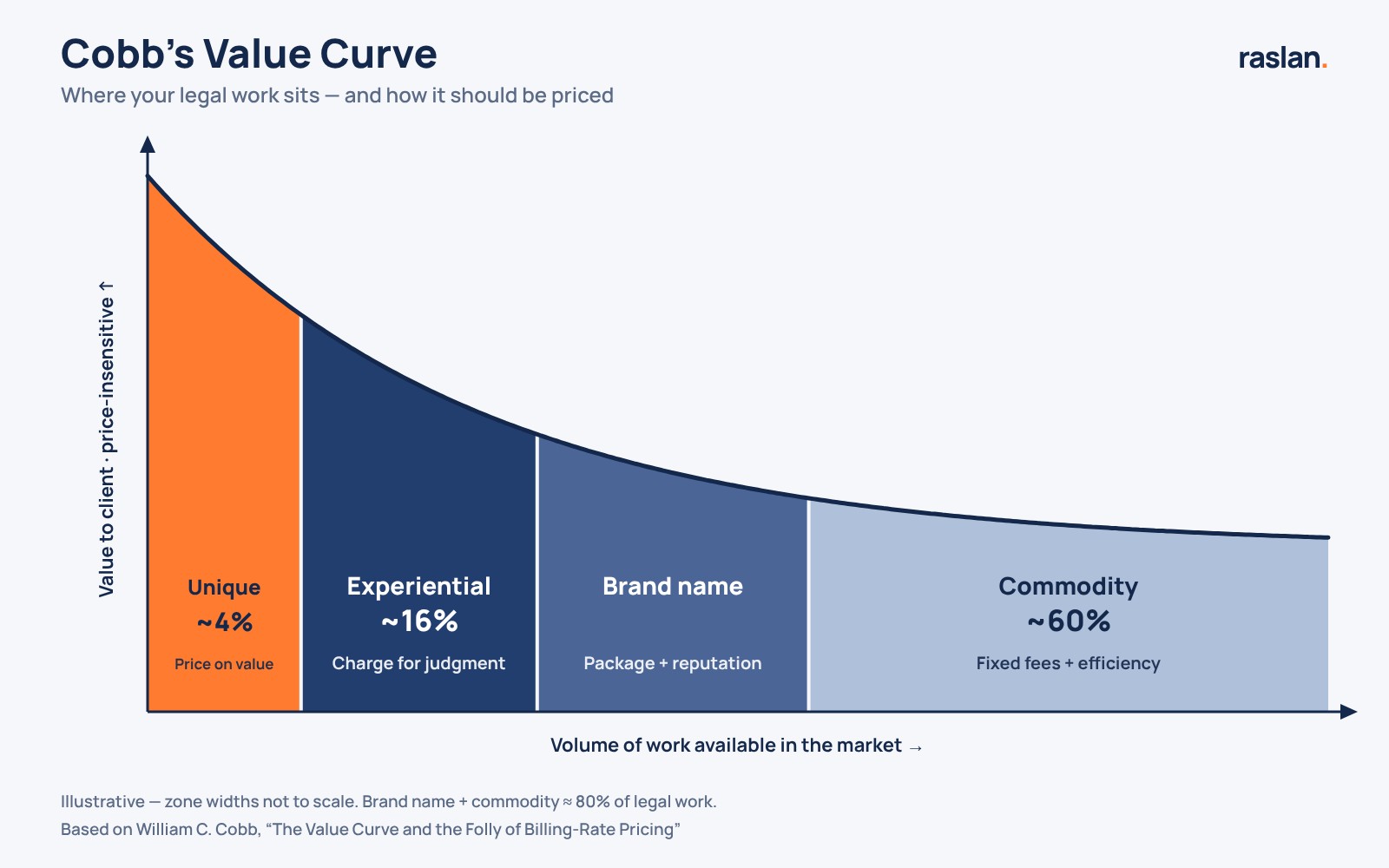
Together, brand-name and commodity work make up roughly 80% of all legal work. That is where most firms compete—and where most of them leave money on the table by pricing it the same way they price their best work.
What each zone means for your pricing
- Unique: Price on the value of the outcome, not the hours. Premium rates, success components, or a fixed fee set high enough to reflect what is at stake. Discounting here signals that you don’t believe your own value.
- Experiential: Charge for judgment. Senior time is the product, so price it with confidence and explain the risk your experience removes.
- Brand-name: Package the service. Give a clear scope, a clear fee, and proof of your reputation in that exact area—case results, clients served, published thinking.
- Commodity: Make it efficient. Fixed fees, standard templates, junior lawyers and technology. Your margin comes from process, not from the rate.
Where firms usually go wrong
- One rate for everything. The firm undercharges for its rare, high-value work and overcharges for routine work—and loses clients on both ends.
- A cost structure that doesn’t match the work. Cobb’s point was simple: a firm with high overhead—prime offices, large staff, senior partners—needs a larger share of unique and experiential work. A lean firm can win price-sensitive work and still be profitable.
- Ignoring that work moves down the curve. What was unique ten years ago is often routine today. If your pricing doesn’t move with it, your profit quietly disappears.
Apply it this week
- List your last 20 matters.
- Place each one in one of the four zones. Be honest about how the client saw it, not how you saw it.
- Count how much revenue came from each zone—and how much partner time went into each.
- Compare that mix with your overhead. Does your cost structure fit the work you actually do?
- Pick one service in the commodity zone and turn it into a fixed-fee package with a clear scope.
- Pick one matter type in the unique or experiential zone and write down what it is worth to the client. Price from that number, not from the timesheet.
Final thought
Pricing is not an accounting decision. It is a marketing decision: it tells the client how you see your own work. Cobb’s Value Curve gives you a simple way to make that decision deliberately—matter by matter, zone by zone.
Based on William C. Cobb’s article “The Value Curve and the Folly of Billing-Rate Pricing,” published in Beyond the Billable Hour (American Bar Association). Market shares are Cobb’s approximate estimates.
Enjoyed this issue?
Get the next Game Plan in your inbox—one practical marketing playbook for law firms at a time.
Ibrahim helps law firms in Egypt and the Gulf grow through marketing, business development and legal tech. He has led marketing and BD for Kosheri, Rashed & Riad, Shwra, Hekouky, Levari and The Legal Clinic.
More about Ibrahim →